
How Long Does It Take to Dry a Flooded Basement?
Once the standing water is gone, the basement can look and feel almost normal within a day. It isn't dry. Water has soaked into carpet pad, the bottom of the drywall, wall cavities, wood framing and the concrete itself. Drying all of that properly takes days, not hours.
For a typical clean-water basement loss that's dealt with quickly, restoration companies commonly quote about three to five days of drying equipment. Some jobs finish sooner. Heavy saturation, concrete, hardwood, a continuing groundwater problem, or sewage can stretch the timeline to a week or more. This post explains what sets the clock and how you'll know it's actually done.
If the water is still coming in, start with our step-by-step guide to a flooded basement and come back to this once the source is stopped.
Why drying takes longer than it looks
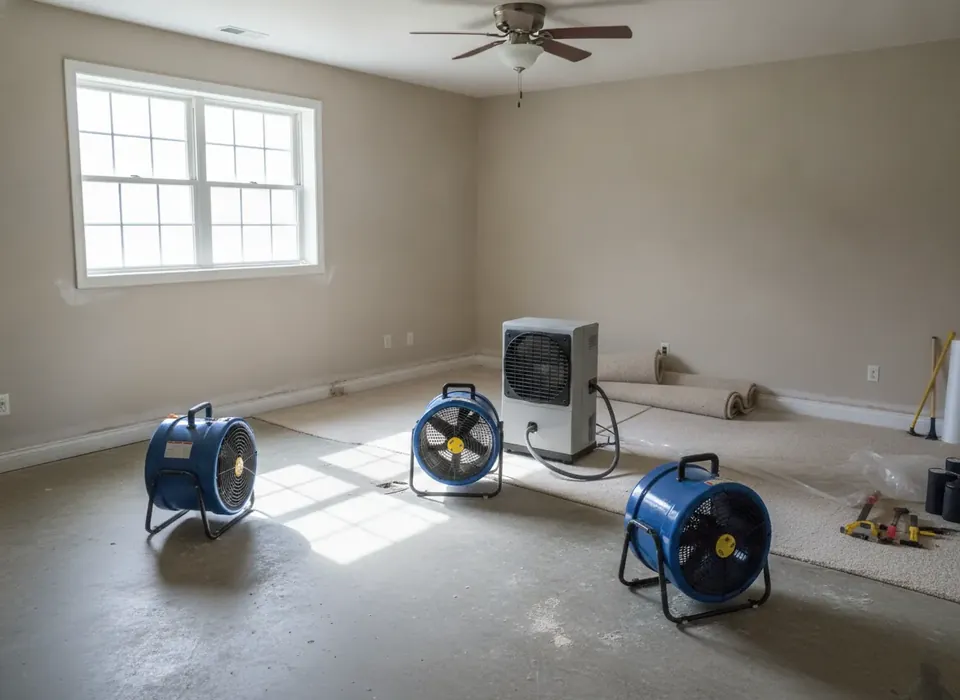
Water damage moves in stages. Extraction pulls out the liquid water, which is fast and does the most good per hour. What's left is moisture absorbed into materials, and it only comes out as fast as it can evaporate and be pulled from the air. Restoration companies use three tools for that:
- Air movers push air across wet surfaces to speed evaporation.
- Dehumidifiers pull that moisture out of the air so it doesn't settle back into the walls.
- Heat helps, which is why a cold basement in January can dry more slowly than the same space in July.
Pointing a box fan at a wet wall moves damp air around without removing the water, and it can push moisture into other rooms.
What sets the drying timeline
How much got wet (the class of loss)
The industry sorts jobs into four classes. Class 1 is a small area with little absorbed water. Class 2 is a whole room with water wicking up the walls. Class 3 is the worst saturation, often with water from above soaking ceilings and walls. Class 4 is "specialty drying" for dense materials such as hardwood, plaster and concrete, which hold water and release it slowly. National guides price these from about $150 to $400 for Class 1 up to $20,000 or more for Class 4 (Fixr, 2025), and the time scales the same way.
What kind of water it was
Clean water from a supply line is the simplest case. Gray water from a washer or dishwasher, and especially black water from a sewer backup or outside floodwater, means porous materials such as carpet, pad and the bottom of the drywall usually come out rather than being dried in place. That can actually shorten the drying stage, because the wettest materials are gone, but the overall job takes longer because of the cleaning and rebuild.
Finished or unfinished
An unfinished basement with bare concrete and open framing dries comparatively quickly. A finished basement has carpet pad, insulated walls and drywall that trap water. Most Utah Valley homes have basements, many of them finished, according to local realtors, so this is the usual case here. The common approach is to remove the pad, make a "flood cut" along the bottom of the drywall, and pull wet insulation so air can reach the framing.
Concrete and foundation walls
Concrete absorbs water and gives it up slowly. A slab or foundation wall can stay wet after everything around it has dried, and new flooring laid over a wet slab can fail. This is often what pushes a basement job past a week.
Whether the water is still coming
Drying can't outrun an active source. A basement taking groundwater during spring runoff will keep re-wetting until the water table drops or a sump pump keeps up. The Utah Geological Survey notes that shallow groundwater problems tend to show up in low-lying areas during snowmelt and heavy rain, and a UGS geologist has recommended sump pumps for affected homes. Window wells that fill during cloudbursts are another repeat source. See our post on window well flooding.
How fast drying started
The first day matters most. Wet drywall and carpet pad are where mold gets started, and the commonly cited window is 24 to 48 hours. A basement where extraction starts the same day usually dries faster, and with less tear-out, than one that sat over a weekend.
Utah's dry air helps, but not enough on its own. Provo's long-term average is only about 17 inches of precipitation a year (NOAA normals for the Provo BYU station), and outdoor air here is often dry. A closed basement full of wet materials still holds humid air, and in winter the outside air is too cold to open windows. Dehumidification does the heavy lifting.
How do you know the basement is actually dry?
By measuring, not by touch. A good restoration company takes moisture readings on the first day, mapping how far the water travelled in floors, walls and framing. It keeps measuring the same spots on each visit. The usual goal is to bring wet materials back to the moisture level of similar unaffected materials elsewhere in the house, often called the "dry standard."
Ask for those readings. A daily moisture log protects you if mold appears later, and it's useful documentation for an insurance claim. Equipment should come out because the numbers say the job is done, not because a set number of days has passed.
A rough timeline for a typical basement
Day 1: Stop, extract, assess
The source is stopped, standing water is extracted, moisture is mapped, and wet pad and drywall are removed where needed. Drying equipment goes in.
Days 2–4: Monitor and adjust
Readings are taken, and equipment is moved toward the areas still wet. Most clean-water basements show steady progress here.
Days 3–5 or later: Confirm dry
When readings reach the dry standard, equipment comes out. Concrete, hardwood and heavy saturation can add days.
After drying: Rebuild
Drywall, insulation, paint and flooring go back in. That's a separate stage of construction work by a DOPL-licensed contractor, and it often takes longer than the drying itself.
What drying costs
National cost guides put drying a 500-square-foot basement at about $2,000 to $7,000 before any repairs, and a typical whole water damage job at $1,200 to $5,000 (Fixr, 2025). The Salt Lake City metro average, the nearest Utah figure, is about $5,256 (Angi). Every extra day of equipment adds to the bill, which is one more reason quick extraction pays off. Our Orem water damage cost guide has the full table and a calculator, and the emergency extraction and drying page explains how the equipment work is done.
Can you dry a flooded basement yourself?
A small amount of clean water on bare concrete, caught right away, is often manageable with a wet-vac, a rented dehumidifier and patience. Once water has soaked into carpet pad, gone up drywall, or come from a sewer or outdoors, DIY drying tends to leave moisture inside the walls, where it shows up later as odor, staining or mold. If you're unsure, a moisture reading is the cheapest way to find out.
If you'd like quotes, describe the water once on our free quote form. Independent restoration companies in Utah Valley will contact you directly, and many of them typically offer 24/7 emergency response.
Questions people ask
How long does it take to dry out a flooded basement?
For a clean-water loss handled quickly, restoration companies commonly quote about three to five days of drying equipment. Concrete, hardwood, heavy saturation, ongoing groundwater, or sewage can stretch that to a week or more. Moisture readings, not the calendar, decide when it's done.
Can a basement dry on its own?
Surfaces may feel dry within a day, but water trapped in carpet pad, drywall, framing and concrete dries very slowly without air movers and dehumidifiers. That trapped moisture is what leads to odor, staining and mold.
How do I know when my basement is completely dry?
Ask for moisture readings. A restoration company measures wet materials daily and compares them with similar dry materials elsewhere in the house. Equipment should come out when the readings match, and a written moisture log is useful for insurance.
Should I open the windows to dry my basement?
Only when the outside air is drier and warmer than the basement. In a Utah winter it usually isn't. Dehumidifiers running in a closed space generally dry a basement faster and more predictably.