
Hard Water and Water Heater Leaks in Orem
Orem's water is hard, and in some parts of the system it's very hard. The city's 2026 Water Quality Report gives sampled hardness from 2018 to 2025 of 120 to 428 mg/L, or about 7 to 25 grains per gallon, depending on the source. The Water Quality Association treats anything over 10.5 grains per gallon as "very hard." That mineral load is one of the quiet reasons water heaters in Utah Valley wear out, and because most local water heaters sit in a basement, a failed tank tends to land on carpet and drywall.
Here's what hard water does to a tank, the warning signs to watch for, and what to do if yours starts leaking.
How hard is Orem's water, and why does it vary?
Orem blends several supplies. According to the city's report, about 60% of its water is surface water from the Provo River system (Deer Creek and Jordanelle), treated at the Don A. Christiansen Regional Water Treatment Plant. The other 40% is groundwater: nine deep wells supply about 25% and two Provo Canyon springs supply about 15%. Treated surface water tested at roughly 6.5 to 9 grains per gallon. Some groundwater sources run much higher. Because the sources mix in the system, your tap's hardness depends on where you live and on the season.
Provo is in the same range. A third-party dataset that cites Provo's annual report lists Provo City water at about 200 ppm, or 11.7 grains per gallon.
Calcium and magnesium, the main hardness minerals, aren't a health concern. They are a plumbing concern.
What hard water does to a water heater
Heat pulls dissolved minerals out of water. In a tank heater they settle to the bottom as scale and sediment. Over the years that layer:
- Insulates the water from the burner or element. The heater runs longer to do the same job. A popping or rumbling gas tank is often water boiling under a crust of sediment.
- Overheats the bottom of the tank. That steel is where many tanks eventually rust through.
- Eats the anode rod faster. The anode is a sacrificial metal rod that corrodes so the tank doesn't. Once it's spent, the tank starts corroding instead.
- Clogs the drain valve, which makes flushing harder the longer it's put off.
Plumbers along the Wasatch Front report that tank water heaters typically last 8 to 12 years, with hard water pushing toward the low end, and some suggest checking the anode rod every 2 to 3 years. Those are trade estimates, not guarantees, but they're a useful yardstick. If your tank's label shows it's past ten, start watching it.
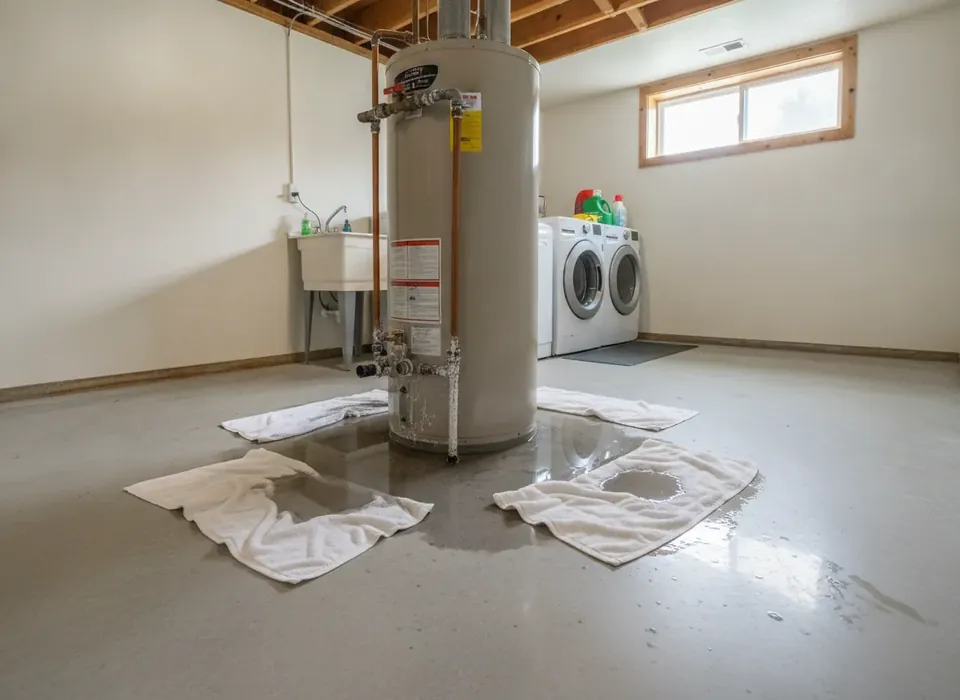
Warning signs a tank is close to failing
- Rust-colored hot water, or rust on the tank jacket near the bottom.
- White crust or green corrosion on the valves and fittings on top.
- Popping, rumbling or knocking while it heats.
- Hot water running out sooner than it used to.
- Moisture or a small puddle under the tank, or water in the drain pan.
- A temperature and pressure relief valve that drips or has left a trail down the discharge pipe.
Any one of these is worth a plumber's visit. A slow weep can turn into a split seam without much more warning.
Why a basement water heater leak gets expensive
Most Utah Valley homes have basements, many of them finished, according to local realtors. The water heater and furnace usually share a utility room beside a family room or bedroom. A 40- or 50-gallon tank that fails will empty onto the floor, and the cold supply keeps refilling it until someone closes the valve. Water wicks under the wall plates into carpet pad and up the drywall in the next room.
Orem's housing stock adds to the risk. The Census Bureau's American Community Survey puts the city's median year built at 1989, with 37% of homes built before 1980. Many of those homes are on their second or third heater, and the shutoff valves, flexible connectors and drain pans around the tank may be decades old.
If the tank is leaking right now: close the cold-water valve on the line above the heater. If it won't turn or the leak is at the valve, shut the house main. Turn a gas heater to off, or switch off an electric heater's breaker if you can reach the panel without standing in water. Then move what you can off the wet floor and take photos before cleanup starts.
Other hard-water leak points in the house
The tank isn't the only thing scale shortens. In hard-water homes these are worth checking every year or two:
- Washing machine hoses. Rubber hoses crack with age. Many people replace them with braided hoses and turn the valves off when away.
- Refrigerator ice-maker lines. Thin plastic lines behind the fridge get kinked and brittle.
- Water softeners. Softeners help with scale, but the bypass valve, brine tank and drain line are themselves leak points, often in the same utility room as the heater.
- Toilet and faucet supply connectors. Crimped ends on flexible lines corrode in mineral-heavy water.
- Dishwasher supply and drain connections under the kitchen sink.
Our water heater and appliance leak page walks through how cleanup works for each of these.
How to slow the damage
Flushing the tank removes sediment before it hardens. Many manufacturers recommend at least an annual flush; check your heater's manual, since hard water may call for more. If the drain valve won't open, won't close fully, or the water never runs clear, stop and call a plumber. A brittle plastic drain valve that cracks mid-flush is a common way maintenance turns into a wet floor.
A softener can reduce scale buildup. Ask a plumber to check the anode rod during routine service. Put an inexpensive water-leak alarm on the floor next to the heater and the washer, and make sure everyone in the house knows where the heater's cold-water valve and the main shutoff are.
Plumber or restoration company?
Often both. Replacing or repairing a water heater is plumbing work, and in Utah plumbing must be done by a licensed plumber, even on small jobs. If water reached carpet, drywall, cabinets or the room next door, a restoration company handles extraction, moisture mapping and drying. Clean water from a supply line is the least costly category: national guides put extraction at about $3.75 to $4.25 per square foot, and drying a 500-square-foot basement at about $2,000 to $7,000 before repairs (Fixr, 2025). See the Orem water damage cost guide for the full table.
On insurance, a sudden tank or connector failure is more likely to be covered for the resulting water damage. The worn-out heater itself, and damage from a slow leak that went on for months, often isn't. Every policy is different and your policy's deductible applies, so check your policy and ask your adjuster.
When you're ready, describe the leak once on our free quote form and independent Utah Valley companies will reply with their own quotes.
Questions people ask
Is Orem water hard?
Yes. Orem's 2026 Water Quality Report gives sampled hardness of 120 to 428 mg/L, about 7 to 25 grains per gallon, depending on the source. Anything over 10.5 grains per gallon is considered very hard on the Water Quality Association scale.
How long does a water heater last in Utah Valley?
Plumbers along the Wasatch Front report that tank water heaters typically last 8 to 12 years, and hard water tends to shorten that. Rust-colored water, popping noises, and moisture under the tank are signs it's time for a plumber's inspection.
What should I do first when my water heater leaks?
Close the cold-water valve above the heater, or the house main if that doesn't work. Turn off the gas or the heater's breaker if it's safe to reach. Photograph the damage, then call a licensed plumber for the heater and a restoration company if water spread to flooring or walls.
Does homeowners insurance cover a leaking water heater?
Policies often cover sudden water damage from a tank failure but not the heater itself, and many exclude slow, long-term leaks. Coverage varies, so check your policy and ask your adjuster. Your policy's deductible applies.